Friday, November 27, 2009

Wishing All a Happy & Blessed Holiday Season!

I hope that after a long season of football, we all find that we can put things back into perspective and enjoy family, friends and all that we have to be thankful for!

God bless all who visit here!

Saturday, November 14, 2009

Dukes Break Records and Mold to Win 45-42

Charlie Leventry snuck in a 31-yard field goal as time expired to finally reward a series of good performances by a number of Dukes. It almost felt like Leventry forgot to read the playbook that the kick was supposed to go just wide so that the Dukes could add yet another agonizing loss to the season.

Up until joining the NEC, Duquesne played with the attitude that it was supposed to win every game it played. For the past two years, the Dukes have been finding creative ways to outplay an opponent and then to find a way to lose. They seemed to be doing the same thing in the second half after being up 21-7. Time and time again, the Dukes left receivers uncovered or took costly penalties or kept kicking off out of bounds to keep opening the door for Sacred Heart to come back and win. Aside from the dismal and unexplainable loss to St. Francis, Duquesne’s game plan seemed to be to outplay the opponent, but refusing to win. Larry McCoy, Kevin Rombach, Conner Dixon and yes, even the kicking game finally found a way to win.

· McCoy tied a school record with 5 touchdowns to go with 121 yards. He ran with both talent and will power.
· Kevin Rombach set a passing percentage record by throwing for 26 completions on 30 attempts (.867) for 252 yards.
· Conner Dixon made 6 catches for 96 yards- His most important was his last which set up the winning field goal as time ticked away.
· Charlie Leventry kicked the pressure filled 31 yard field goal as time expired. Eric Dule, Duquesne’s regular kicker was left back in Pittsburgh with an illness.
· Jay Spinks added another 8 catches
· Duquesne over all converted 12 of 18 3rd downs on their way to gaining 450 yards.

Duquesne closes out the season with Senior Day at home vs. Bryant.

Saturday, October 17, 2009

Dukes Lose Another Close One: Patterson Takes His Turn

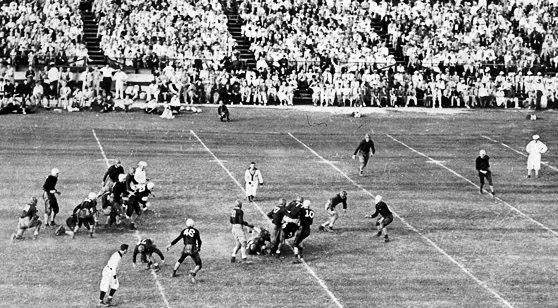
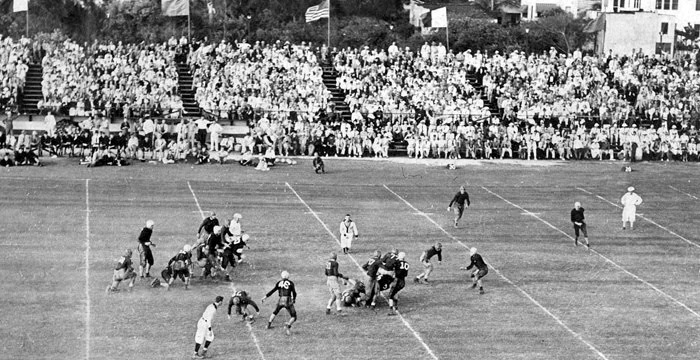
One of the most precious gifts I had ever received from my father-in-law (aside from my wife of course) is a vivid memory of his he shared of a Duquesne quarterback. It was from the 1936 Orange Bowl when he told me in intimate detail of a late game 72 yard touchdown pass from Boyd Brumbaugh to Ernie Hefferle to pull out a 13-12 Duquesne win against Miami. He must have only heard the game on the radio and read about it in the papers later, but his eyes could still follow the pass through the air as he told me that the pass arched 69 yards in the air. Brumbaugh was an honorable mention All American and would late play for the Steelers. However, he generated no more golden memories for my father-in-law to share.

Brumbaugh’s collegiate statistics as quarterback and Duquesne’s major college football program did not outlive my father-in-law’s memories. Duquesne’s program went from being one of the best in the nation just prior to World War II to extinction in 1950.

Duquesne, of course would re-start its program in 1969, but would not re-joint Division I (1-AA/FCS) until 1993. Since 1993, a talented crop of Brumaugh’s heirs at quarterback has blessed Duquesne. If Penn State is known as Linebacker U. has successfully recruited a group of very skilled quarterback.

Current receivers coach Dave Loya (1994-97), was the first modern QB of the era, ending his career in possession of 13 of 15 Duquesne quarterback records. Dave, recently engaged, would lead the Dukes to “Mid-Major” prominence and would earn the first of many MAAC Conference Championships. He also has had the agony or pleasure of seeing most of those records gradually surpassed as he coached from the sidelines.

Tony Zimmerman ((1998-2000) would take over after Dave’s four years as starter and would only need three years to break his mark for career passing yards, touchdowns and completions.

Neil Loebig (2001-04) didn’t miss a beat as he pushed the passing records further. As he learned from Loya, Neil currently directs the Duke’s passing game.

From there, the records stopped falling…

It is not due to a shortage of talent. Scott Knapp (2005-07) was well on his way to working into Duquesne’s record books, but lost his job to another highly skilled quarterback, Kevin Rombach (2005-09). Kevin had a Redshirt season in 2006 and was, like Knapp, the apparent heir to the throne with the highest completion percentage of them all. Knapp left the University early. Kevin lost his crown to Conner Dixon, also an excellent quarterback who transferred in with considerable publicity and expectations from Michigan State.

Dixon couldn’t have had a better start during last year’s Bucknell game, setting the record for the most touchdowns in one game. No Duquesne fan could have predicted the lack of consistency since.

Finally a new, young talented quarterback has made a challenge for the title. Sean Patterson started today against Central Connecticut and played reasonably well in the 31-24 loss. Today’s loss was not due to the inexperienced Patterson. It was due to continued and chronic mistakes and lack of focus. The Dukes lost another close game they could have and should have won. A blocked punt late in the game set up the Blue Devils winning score.

This coaching staff must take a long look at itself and determine just who they are going to develop put their confidence in. They are turning unlimited potential into limited liabilities. The most important position on any team is its quarterback. The position requires time to learn and time to learn the offense and make it his own.

One suggestion would be to move Dave Loya, the guy who started it all, back to running the passing game as quarterback’s coach. Dave is a proven coach who ironically brought the present quarterback’s coach along to break his own records.

Some day, Duquesne may have an established leader and quarterback to help them gain focus in the locker room and on the field. And some day, I hope to have my future son-in-law hear my stories of the great quarterbacks from Duquesne. I wonder if he will find them as interesting?

Saturday, October 10, 2009

The Bright Side of an Albany Blow Out

Can there be a “bright side” to a 55-10 blowout? After waiting a few hours and looking over the game stats, the answer actually may be “yes”.

Consider the following…

Duquesne went into mighty Albany’s house on Homecoming. The Great Danes haven’t lost a game to an NEC opponent for the past 16 games.

Albany is not only playing toe to toe with the best teams in the FCS, but is now scheduling Big East member Cincinnati.

Duquesne had more first downs (22-17), passing yards (221-193), time of possession (34:00 to 26:00), and even higher yards per punt average. The Dukes forced the same number of punts as well.

Conner Dixon put up decent numbers against a tough defense (20-31 for 194 yards and a touchdown).

The overall yards (unless you add in the return yardage) didn’t reflect the final score.

So why the 55-10 score?

The Dukes made the same amount of mistakes that they have all year to a much better team. It started on the first play from scrimmage for the Dukes, losing a fumble to set up Albany’s first score. They went on to fumble three more times and added an interception. Their punting average was 33.5 yards (Albany’s was 31.7).

Most damaging were the big plays and Albany’s ability to make Duquesne pay for every mistake and lack of focus. The Dukes have been making mistakes and have had trouble focusing all year and it has cost them each time. With the exception of this game the Dukes could make an argument that they could have won all the others this year.

The Dukes seem to have the talent (except for a punter and other costly spots). They have had costly injuries to key players but have shown depth.

If Duquesne could ever match the focus and attitude of Albany, they would be in the middle of a wining season. The Dukes must learn that focus, or they will always be a talented team that can't win.

Albany to the CAA?

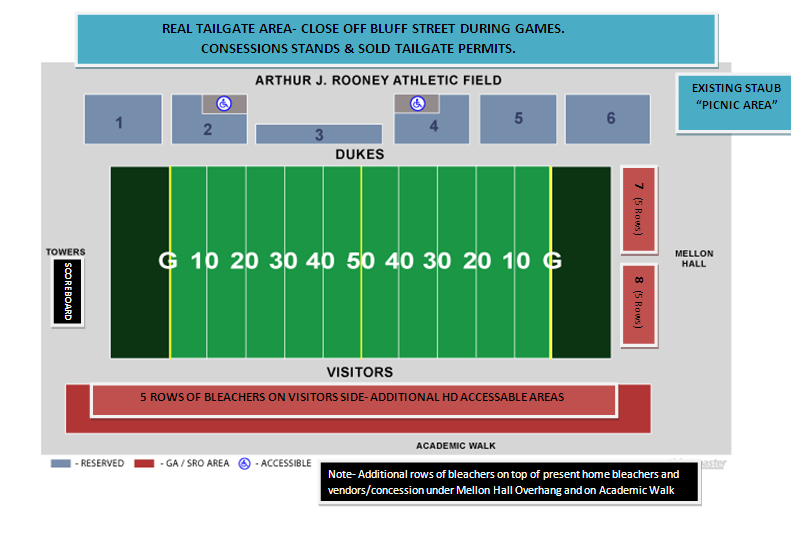
Albany is doing all of the things I would hope that the Dukes would do to bring their program to FCS excellence. Ironically, its the same recipe the Dukes used to go from a Club team to D-III to D-1-AA. They scheduled up, moved to a scholarship conference, they started building a collegiate atmosphere with an new field, press box and worked with a band. Then, all of a sudden the Dukes took back to a D-III feeling. No band, a short sighted expansion of the field, a tiny "pep" band that can't be heard, no "real" tailgate area (The Straub area is nice, but not a tailgate area).

Football recruits see this and it affects their decisions to come here. It all has to come together. I don't blame Albany for not wanting to stay in this conference and go to the CAA. Duquesne has the smallest field, no band, no tailgate area to lure a crowd, and no longer reaches as dramatically above their conference. And when they do shedule Delaware, they will not have as much of a chance to compete evenly due to this minor league attitude. NAIA and high school teams have a better band, stadium, tailgate, and press box. A guy trowing a frisbee to his dog is not a half time show.

After last year's game the Dane's fans thought that the Dukes would help the NEC's image, but If Albany leaves, it will be due, in part, to Duquesne short sighted imagination to build a REAL FCS team and atmosphere that goes with it.

Sunday, October 4, 2009

Dukes Hold Off Cross-Town Colonials 34-20

Duquesne held off Robert Morris in an emotion filled, but sloppy game typical of these cross-town NEC rivals this year. The Dukes looked to dominate the contest by building a 27-0 lead into the third quarter before wise old Joe Walton decided his offense needed to take the red-shirt off freshman quarterback Jeff Sinclair. The Highlands grad got used to the collegiate play by the third quarter and led the Colonials to within a touchdown before the Dukes got themselves re-focused for a final drive to put the game away.

Duquesne got in a freshman quarterback of their own by letting prospect Sean Patterson lead them to a 37 yard touchdown drive for the Dukes’ second score. Larry McCoy had yet another 100-yard game with 107 yards on 20 carries with 13 and 11-yard touchdown runs. Joe Cangilla looks to be the latest in a talented stable of receivers, pulling down three passes for 68 yards. His most impressive was a leaping 27 yard catch from Conner Dixon to set up the Dukes’ last touchdown. Dixon was 19 of 31 for 201 yards while Patterson went 1 for 2 for 11 yards.

Duquesne was able to overcome 3 turnovers (2 fumbles and an interception), a muffed punt, a missed extra point and over 100 yards in penalties to miss shooting themselves in the foot for the fourth week in a row. Duquesne, with less mistakes, could easily be undefeated rather than 2-3 if they could ever sustain the focus that built them a 27-0 lead in this game. The Dukes’ kicking game, which helped to frustrate decent chances to win the past three games, helped the Colonials considerably by giving Robert Morris the ball at Duquesne’s 15 yard-line and missing the second chance at an extra point after a penalty.

Duquesne took a lead in the overall series against Robert Morris 6 games to 5. Next week, the Dukes travel to last year’s NEC Champion Albany for a 1:00 game heard on WMNY and Redzone Media.

Saturday, September 26, 2009

By Shaler Tom from the Football Forum

Subject: Back from Dayton

Author:
Shaler Tom

Date Posted: Saturday, September 26, 11:47:05pm

I wonder if three straight tough road games finally caught up with the Dukes today. It seemed to me as I watched from behind the bench that the boys just weren't in it mentally or physically.
After a 67 yard run by Larry McCoy on the opening play, which to be honest was created by a missed tackle on a simple dive play, the Dukes shot themselves in the foot, over and over again.
A blown coverage led to UD's first TD, a 58 yd pass that tied the score. This was on a second and 18 play!
Duquesne, on its best drive of the game, went 66 yards but had to settle for a field goal and led 10-7. The Dukes had a chance to stretch the lead near the half, but with a 4th and 1 at the 15 were called for a false start and then missed a 32 yard field goal.
In the third quarter, another blown coverage and TWO missed tackles resulted in a 62 yard TD putting Dayton up 14-10.
After a 29 yard punt, the Flyers started in good position and drove for a field goal. 17-10
A one yard run, a dropped pass, a QB sack and a 28 yard punt put Dayton in good position again. Steve Valentino, the aforementiond WR turned QB, began to chew up our defense on the ground with ease. The boys were tired and over pursued. A face mask penalty contributed to the Flyer drive, 24-10.
Friends, this was a TEAM loss. The offensive line play was poor, take away McCoys TD run and the backs ran for 68 yrds on 30 plays. Dixon looked shakey. He was hurried and hit on almost every pass play. He did throw some nice balls but just as many poor ones. Our recievers had some drops that would have kept drives alive, our special teams were terrible and the play calling.....very, very predictable. Our linebackers were outstanding as usual, Totino and Scruggs were the lone bright spots in my opinion. Our D-line was suckered into an over-pursuit all day long and our DBs were torched.
As most of you know, I try to be optimistic, but this one was tough to watch. I'm hoping that it was simply a case of too much travel in too few days.

Filling In Duquesne's Football Tradition: 400 Wins This Year?

If you pick up a Duquesne Football Media Guide you'll notice that much of the Duke's earliest football record is incomplete. There are entire years where the team played, but there are no records to indicate how they did. I know that some people may think caring about this is more an excersize in historical trivia, but others may feel that it is a recognition of Duquesne's proud athletic history and tradition.

For example, how many times did Duquesne play Pitt on the football field and what was their record? Duquesne's media guide lists the record at 2-4 with the recognized games being in the 1930's when Duquesne and Pitt were both nationally ranked powers.

Pitt's football records are a bit more complete and show that the first Pitt-Duquesne game turned out to be an 18-0 Pitt victory over the Dukes in 1901. However, the Panthers don't recognize a loss to Duquesne in 1903 by a score of 10-6.

Part of the reason for the confusion could be that Pitt, at the time of both earlier games was known as the Western University of Pennsylvania and Duquesne was officially known as the Pittsburgh College of the Holy Ghost.

Instead of Duquesne's Media Guide record of 2-4 and Pitt's version of 2-5, the actual record is 3-5. This record is now verified by the College Football Data Warehouse.

By cross checking available on-line records from Pitt, West Virginia, Washington and Jefferson, Geneva, University of Buffalo, Bethany, California University of PA and others, Duquesne's documantable all time record should stand at 395 wins, 287 losses and 25 ties.

Duquesne's Media guide does not include a proud 1891-1901, first decade record of 33-17-5 in its all time record. It also does not list Duquesne's first documented collegiate game, a 1893 loss to Washington and Jefferson by a score of 22-19.

It would be a great recognition of a proud football tradition to claim our 400th win if it occurs this year!

MAJOR COLLEGE FOOTBALL 1941: THE DUKES WERE # 1 !

No kidding- The Massey Ratings rank the 1941 Dukes the #1 Major College Football Team in the Nation. That team went 8-0 and was one of three undefeated, untied teams in the nation that year along with Duke and Minnesota. They gave up only 21 points all season to lead the nation in scoring defense, rushing defense and total defense. The AP ranked the Dukes #8 that year. See these links- http://www.cfbdatawarehouse.com/data/div_iaa/northeast/duquesne/all_national_champs.php

http://www.masseyratings.com/cf/years.txt


More About Duquesne and Major College Football Rankings

Many recognized collegiate football ranking systems begin declaring national champions dating back to 1869 when Princeton was declared national champion by most systems. Controversy exists even in that year’s selection of the nation’s best by some systems rating Rutgers at the top. Back then there were no polls taken by sports writers such as the AP Top 25 or the USA Today Poll or the now defunct UPI Coaches Poll.

The most familiar and accepted current system, The Associated Press only released their first collegiate football ranking in 1934. No AP Poll was released in 1935 but they have been releasing continuous rankings since 1936. The only inconsistency with the AP Poll since 1936 relates to the years when they would not issue a final yearly ranking after the college bowl games.

College football teams from 1869 to the present are ranked very accurately and without regional prejudices by statistically based systems such as the Sagarin, Massey, RPI, Dunkle and other computer models. Most of these commonly accepted and statistically sound models are fairly consistent since they all basically look at a teams record against their strength of schedule. Their formulas as to how to factor in data from when in the year a team lost or home field advantage do rate teams differently.

Thus, even when bias from a sports writer, coach, or fan is not considered, there is seldom a year when all agree as to who is the nation’s best college football team. Even then, who is to say the fans, coaches and writers shouldn’t have a say over cold computer calculations.

The current BCS System makes an effort to achieve some consensus by relying on both polling data and computer ranking systems. Obviously, even the BCS Series Rankings has never made all of the people happy all of the time.

This debate and controversy over whose team is the best is really part of what being a college football fan is all about.

Duquesne’s National Major Football Championship

All this being said, there was a time and respected system that has declared the Duquesne Dukes the National Champion. That honor belongs to the undefeated and untied 1941 edition of the Duquesne Dukes. This rating is no fluke. The ’41 Dukes gave up only 21 points all season and were led the nation in scoring defense, rushing defense and total defense. No major college team since has given up fewer points.

Only Duquesne, Minnesota and Duke finished the 1941 season undefeated and untied among major programs. Admittedly, Minnesota has been recognized by most ranking systems, including the AP as being the # 1 team in the nation that year. However the Massey Rating System has looked at the data and declares Duquesne to be the #1 team in the nation that year.


The Massey System.

The first questions that most would ask are what is the Massey system and is it legitimate? It is legitimate to the point that the current BCS Series currently uses it to determine which teams are selected to play in the BCS Bowls and for the National Championship. The Massey Ratings may be the most scientific and full-featured system available.

Kenneth Massey has been doing these ratings since 1995 and offers previous ratings back to 1930 based upon available data. Massey’s system takes no short cuts. For example, most ratings give a standard home field advantage factor of about 4 points to all home teams. Massey makes the home field advantage factor more precise by analyzing each team’s performance at home vs. away and neutral site games to determine a more accurate facet in rating teams. In other words, winning at home doesn’t and shouldn’t have the same degree of advantage for all teams rated.

The Massey Ratings are also thought to be considerably accurate when considering strength of schedule. This is no easy task when considering the college football world of 1941 when the best in the country often still played considerably lesser-developed programs.


National Major College Football Classifications and Ratings

Duquesne’s first team was fielded in 1893. As most other college teams of the era, the original Dukes’ opponents were not necessarily from other colleges. They included athletic clubs and even high school teams. Nor were there restrictions that all team members had to be current or former students. This began to change as the Intercollegiate Athletic Association of the United States (IAAUS), was established on March 31, 1906 to set rules for college athletics. The IAAUS became the National Collegiate Athletic Association in 1910.

Prior to 1937, ranking colleges was difficult since programs varied widely as to the class of opponents each school would play. Going undefeated against a schedule that included Notre Dame, Penn State and Michigan was obviously more impressive than one that included lesser opponents. With the advent of Bowl selections, the college football had to start separating the apples from the oranges.

In 1937 the NCAA began issuing a system that divided its collegiate football programs into Divisions and placed restrictions on how often teams from each division could play each other. In 1937, the top division was the “University” or “Major College” Division. In 1973, The NCAA restructured its classifications to rename the major programs “Division I”. Division I was subdivided into “I-A” and “1-AA” in 1978. Currently, Duquesne plays in Division I-AA or as the NCAA now officially calls it the “Championship” Subdivision of Division I vs. the “Bowl” Subdivision. Other current NCAA Divisions are II and III. The NAIA and the NCCAA govern smaller college athletic programs.

Massey considered all 119 NCAA Major College football programs when he ranked Duquesne # 1 in 1941. (See link at- http://www.masseyratings.com/cf/years.txt )


Duquesne’s Past Collegiate Classifications

Until the NCAA began to define the caliber of competition, Duquesne was considered an “Independent” collegiate football team along with all other college teams. When the University or Major Division was established in 1937, Duquesne was among this group of just over 100 other colleges and universities. Massey’s 1941 rating considered 119 Major Division teams when it selected Duquesne # 1 in the nation.

Unfortunately, just as Duquesne Football was reaching its highest potential nationally, the team was cut by the University due to the Second World War. Both the AP and Massey had ranked Duquesne teams throughout the 30’s and 40’s prior to the war. Massey ranks the 1933 Dukes at #8 and the 1936 Dukes # 2 in the nation. The AP ranks them at # 14 and # 8 respectively.

Duquesne briefly tried to re-establish the team after the war as a Major Division program, but gave up after the 1950 season. Students and volunteers would start Duquesne’s next team as a club.


Duquesne’s Other National Collegiate Football Championships

When Duquesne re-started its football program in 1969 as a club team, it was sanctioned by the now defunct NCFA. Duquesne was recognized as the National Club Champions in 1973 when they went 10 – 0 under coach Dan McCann and defeated Mattatuck 13-7 in the National Championship game played Three Rivers Stadium.

In 1979, the University again took over sponsorship of the program as an NCAA Division III program. Interestingly, Division III would be the only classification where Duquesne Football could not claim a national championship rating or ranking.

The program would be “upgraded” again in 1993 when it would move to the NCAA Division I-AA. However, the move to I-AA did not necessarily mean that the Dukes would be able to compete on even terms with most other I-AA programs since they would join an odd group of schools who were considered I-AA, but would not be allowed to award scholarships and would have severe limitations on the amount of money they could spend on travel or coaching staffs. This “cost containment” approach to keeping the university at the NCAA Division I for the rest of the school’s athletic programs would evolve into a strange subdivision within the I-AA subdivision known at the “Mid-Majors”.

The Sports Network (TSN) and Don Hansen’s Weekly Football Gazette both developed a bit of love for this odd group of so-called major programs who would not or could not commit the resources to compete with the other major programs of Division I-A and I-AA. Generally, there were about 30 college programs that would either play as independents or populate the Metro-Atlantic Athletic Conference, the Northeast Conference and the Pioneer Conference. All three were officially recognized by the NCAA as belonging to the I-AA Division, but were not given automatic berths to the I-AA Playoffs.

Duquesne would come as close as any of the Mid-Majors to competing with their better-funded I-AA brothers. Greg Gatuso’s squad often played scholarship programs and often won. Not only were these Duquesne team often ranked # 1 by the TSN and Hansen Polls, but were often ranked in the regular I-AA polls. Their highest ranking in the National I-AA Coaches Poll was # 14 before losing their only game of the 2002 season to Albany in the ECAC Classic. Both the TSN and Hansen rankings would select the Dukes the following years as the # 1 Mid-Major National Champions in 2003 when they beat Monmouth to win that year’s ECAC Classic.

Now the “Mid-Majors” are no more. Duquesne and most of the other Mid-Majors have either begun to offer scholarships or have folded.

The Dukes have laid at least partial claim to National Football Championships from the Club level to the I-AA Mid-Majors to, according to the Massey Ratings, the Major College level. What does the future hold for the Dukes at the regular I-AA level now that they have begun to award scholarships? The NEC, the Duke’s new conference will be eligible for a bid to the Division I-AA National Championship beginning in 2010.


The 1941 Massey Ratings


1941 Teams Rated: 119
Team W L T PF PA Off Def Sched Rating Dom

1 Duquesne 8 0 0 17.88 2.62 4 2 44 33.84 0.736
2 Minnesota 8 0 0 23.25 4.75 5 4 41 29.26 0.609
3 Mississippi St 8 1 1 19.10 5.50 28 1 4 26.63 0.530
4 Notre Dame 8 0 1 21.00 7.11 6 11 49 26.20 0.517
5 Alabama 9 2 0 23.91 7.73 8 8 5 26.09 0.514
6 Georgia 9 1 1 29.00 7.73 3 26 28 23.63 0.440
7 Texas 8 1 1 33.80 5.50 1 36 38 23.50 0.436
8 Oregon St 8 2 0 14.30 4.90 23 3 30 23.21 0.427
9 Michigan 6 1 1 18.38 5.12 17 6 22 22.32 0.401
10 Navy 7 1 1 21.33 3.78 16 7 34 21.97 0.390

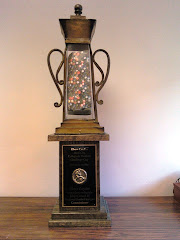
The "Elmer Layden" Cup?

Pittsburgh has almost forgotten its inner-city collegiate football rivalries. There was a time when Art Rooney Sr., Steeler owner and former Duquesne star, had to take the Steelers on the road to sell tickets when Pitt, Duquesne or Carnegie Tech would play each other in Pittsburgh.

Elmer Layden was the first Duquesne coach to play both Pitt and Carnegie Tech (Later Carnegie-Mellon). Layden had been one of Grantland' Rice's famed Four Horsemen of Notre Dame and later went on to become the NFL's first commissioner.

I propose that Duquesne and Robert Morris fans pich in to fund a suitable Trophy named for Layden for the winner of all Pittsburgh Collegiate Football games. Since currently, Duquesne and Robert Morris are the only local teams to play each other, it seems appropriate to present this trophy for the first time to the winner of next year's Duquesne Robert Morris game.

I will set up a trust fund at a local bank for this purpose. I believe that naming this trophy after Layden would also recognize the past glories of Pittsburgh collegiate football rivalries. Any money collected over the cost of the trophy will be donated to the family of a deserving local military family who has sacrificed for their country.

More details will follow.

Past winners of head to head Pittsburgh Rivalry games are listed below.

1901- Pitt over Duquesne 18-0
1903- Duquesne over Pitt 10-6
1910- Pitt over Carnegie Tech 35-0
1923- Carnegie Tech over Pitt 7-2
1924- Carnegie Tech over Pitt 6-0
1925- Pitt over Carnegie Tech 12-0
1931- Duquesne tied Carnegie Tech 0-0
1932- Pitt over Carnegie Tech 6-0
Pitt over Duquesne 33-0
1933- Pitt over Duquesne 7-0
1934- Carnegie Tech over Duquesne 3-0
1935- Duquesne over Carnegie Tech, 7-0
1936- Duquesne over Pitt 7-0
Duquesne over Carnegie Tech 13-0
1937- Pitt over Carnegie Tech 25-14
Pitt over Duquesne 6-0
Carnegie Tech over Duquesne 6-0
1938- Carnegie Tech over Duquesne 21-0
Pitt over Duquesne 27-0
1939- Duquesne over Pitt 21-13 (Last Pitt-Duquesne)
Duquesne over Carnegie Tech 22-7
1940- Duquesne over Carnegie Tech 14-7
Pitt over Carnegie Tech, 6-0
1941- Pitt over Carnegie Tech, 27-0 (Last Pitt-Carnegie Tech)
1980- CMU over Duquesne 39-7
1981- Duquesne over CMU 27-10
1982- CMU over Duquesne 19-0
1983- CMU over Duquesne 14-11
1984- CMU over Duquesne 20-14
1985- CMU over Duquesne 31-10
1986- CMU over Duquesne 33-22
1987- CMU over Duquesne 17-13
1988- CMU over Duquesne 24-14
1989- Duquesne over CMU 11-10
1990- CMU over Duquesne 31-8
1991- CMU over Duquesne 28-14
1994- Robert Morris over Duquesne 28-6
1995- Robert Morris over Duquesne 38-20
1996- Robert Morris over Duquesne 28-26 (ECAC Bowl)
1998- Duquesne over Robert Morris 24-22
2003- Duquesne over Robert Morris 33-28
2004- Robert Morris over Duquesne 34-14
2005- Duquesne over Robert Morris 23-12
2006- Duquesne over Robert Morris 27-7
2007- Duquesne over Robert Morris 17-14
2008- Robert Morris over Duquesne 34-27
2009- Duquesne over Robert Morris 34-20

STEEL CITY FOOTBALL RIVALRIES

College football in the Pittsburgh area goes all the way back to 1890 when the University of Pittsburgh played its first recorded game against the Allegheny Athletic Association, losing 38-0. Duquesne would follow a year later in 1891, but their first games are lost to recorded memory. The third of the great early Steel City football rivals, Carnegie Tech, now Carnegie Mellon University wasn’t founded as a school until 1900, but lost no time by starting a team of its own in 1906.

It was in 1901 that that Pitt, then known as Western University of PA, would win the first recorded contest between Steel City teams with a 18-0 win over Duquesne. Duquesne was known at the Pittsburgh Catholic College of the Holy Ghost until 1911. Duquesne or PCC/HG returned the favor in 1903, beating Pitt 10-6. In 1906 Pitt beat up on Carnegie Tech 35-0. Tech got revenge in the next game, but had to wait 17 years in 1923 by a score of 7-2. Duquesne’s teams reached prominence under coach and former Notre Dame Four Horseman, Elmer Layden. One of their standout early players was Steeler founder and namesake of Rooney Field, Art Rooney Sr.. Art Sr. was their quarterback and place kicker in the 1920’s. It took Duquesne’s 41st year after starting a program to play in an inter-city game with Carnegie Tech, drawing 0-0 in a charity game in 1931.

But man, did the Pittsburgh college football rivalries took off BIG TIME after that. All three teams, Pitt, Duquesne and Carnegie Tech, were ranked often in the first national college football rankings put out by the Associated Press.

As the teams became better, the rivalries became bitter. All three teams played nationally known opponents including Notre Dame and the then powerful service academies. But they often faced more determined battles in their own back yards. Both Pitt and Duquesne played in New Year’s Day Bowls, but National Championships were up for grabs when they met during their regular season. Back then only the very top teams played in the Rose, Orange (First known as the Festival of Palms Bowl) and Cotton Bowls. There were no Outback Bowls or the dozens of other modern bowls that cheapen the achievement today.

The college game and its rivalries actually dominated local sports to a point where the same Art Rooney had to take the Steelers on the road to places like Johnstown, Louisville, and New Orleans to sell tickets.

Unfortunately the rivalry between Pitt and Duquesne ended in 1939 with a Pitt loss to the Dukes when the AP then ranked Pitt #1. The Dukes went on to an undefeated season that year, being ranked #10 in the AP. The last game of the great city rivalry came in 1943 when Pitt also ended their series with Carnegie Tech, beating the Tartans handily 45-6. By then, Duquesne had folded its team for World War II and only briefly tried again after the war. Pitt’s rivalries then turned to Penn State and today’s Backyard Brawl with West Virginia.

The Pittsburgh collegiate rivalry lay dormant for decades until Duquesne’s club football team stepped up to Division III and re-ignited their rivalry with the Tartans of Carnegie Mellon. CMU and Duquesne played spirited games from 1980 to 1991 at times even at Three Rivers Stadium. When Duquesne stepped up again to 1-AA, the Steel City Rivalries ended again.

It didn’t end for long. A new collegiate team would be founded a century after Pitt and Duquesne began theirs in Pittsburgh. Robert Morris started from scratch under the direction of former NFL head coach Joe Walton. Duquesne’s series with the Colonials began in 1994 with the Dukes holding a slight edge 5-4. Both teams were consistently ranked at or near the top of non-scholarship 1-AA football. Now, both teams are stepping up in talent when the NEC member Robert Morris began offering scholarships three years ago. Duquesne offered its first scholarship since 1950 when it joined the Northeast Conference this year.

And so, with both teams now in the same conference and stepping up in competition, the Steel City Football Rivalry is on again. The latest edition of the “Battle of the ‘Burgh” takes place this Saturday, October 11 at High Noon at Robert Morris’ Joe Walton Stadium.
Game Notes: The game will be televised live as part of the NEC’s television package, seen locally on Fox Sports Pittsburgh. It is also carried live on radio on AM 1360 WMNY AM 730 WPIT and streaming on the web at redzonemedia.com.

"BELIEVE"- A draft Screenplay

CAN ANYBODY WRITE A SCREENPLAY?
I keep seeing AJAX career at Duquesne made into a movie. Kid comes in to play a first season on a team that wins 3 games with a team that hasn't won in years. He looks at pictures of long ago Dukes teams that were powerhouses, New coach comes in to clear house, but kid convinces coach that HE IS GOING TO STAY. Gets shot along with others on team. Kids gets betrayed by others brought in who fall to their own egos and to bad decisions. Kid works hard along side of a walk-on who didn't even have a scholarship, but came aboard after the shooting. Kid leads freshmen and sophs to Conference Championship.Stay tuned.


I. Opening Scene

Open on a medium to large University Basketball field house where the home team shows some talent, but no will to win.

One play after another of frustration and half effort. The other team (Dayton?) is rubbing it in.

Home coach alternates between yelling and sitting down at the bench looking frustrated and giving up.

Sour fight song plays in background.

Sparse crowd in the stands, most older fans look bored and try to remember past days of glory for the university.

- Announcer- Ray Goss is calling the play and observes the AJ has some raw talent.

Young player gets put in after coach gets disgusted with his upper classmen’s mistakes. He shows some flashes of talent, but team doesn’t respond. Old folks in stands say he plays like Norman Nixon or Mike James, who kid has barely heard of.

Coach gets message that he needs to see the “new AD” the next morning.

II. Press Conference

AD thanking older coach for years of service as press comments, “yea- 3-23 year?:

Kid sitting with other players

New coach is introduced- Positive message, now well received by press, “yea- 9 coaches in 20 years” Kid glares at press.

Goss introduces new coach

New coach has fair record and history of re-building.. Fade as he is speaking of new goals and direction, not well received or believed.

III. New Coach’s Office Waiting Room

One kid after the next leaves the office being told to pack up and leave. They grumble, good luck here at Duquesne, they haven’t won since Nixon.

While waiting In the outer office, kid walks up to older pictures an sees it is Norman Nixon, not Richard they are talking about- Sees his NBA picture, powerful, but soft fight song starts playing in his head. Lost in memories of a team long ago that won the NIT Championship. Picture after picture of championship teams and first black college player drafted into the NBA.

Kid interrupted by tall Scottish player who says “your next”. Coach said I‘m the only one he wants to keep, but I’m not sure I want to.

IV. Coach’s office

Coach unpacking trophies and other pictures. Starts by saying he will do all he can to find a good school for him… sorry for having him loose a year of eligibility… etc.

Kid interrupts and says firmly- “Coach, I’m staying”

Coach keeps talking, kid interrupts again and says “I said, I’m staying”

Coach looks offended and responds- “We’ll see”.

V. Two person practice/Conditioning session.

- Snide comments- “Here comes the Duquesne basketball team”… Two person drills- tall center, vs quick guard.

- Players talk of why they stayed. Scottish player says- I want a good education and to stay in this country

- -Kid, I don’t know why “I’d like to see this team win before I graduate”

- Achara- Really, (laughing) We’ll see… Your serious, aren’t you?


VI. First Practice New players and JUCO transfers

- Coach running team hard, some responding, some not. Focusses on AJAX to run him off the floor. AJAX doesn’t quit. Intro Sam, Kojo, James and Stuard

- Achara get hurt- Asst. to coach “There goes the only one we wanted Coach- “Maybe not”

VII. AJAX’s year montage- mixed success, Egos lose some games, but team gradually starts to respond… Beats best team, but looses last 7 games… Same old Duquesne

Goss calls play/narrates as season goes on

VIII. Dance and Shooting

- Dance shooting, hospital, Sam on life support, Coach there for the players

IX. Third Season
- Duty comes aboard as walk-on to fill out team
- Big success, NCAA rumor, then loses 7 in a row
- Achara comes back and graduates
- Trip to Canada, bonding
- Big success, NCAA rumor, then loses 7 in a row
-Goss calls plays as scenes from various games play. Some buy in, some are selfish still
- Off season drug busts and player transfer out to NBA, but not really

X. Scene with Sam
- Sam, AJAX room mate who he had stayed friends with- “Really think I can do this” Sam ok, but I still can’t think straight still, but if you do, I’ll be with you.


XII. Final scene- laying for conference championship and NCAA berth. Coach/AJAX heart to heart and run down runway to Boardwalk hall Win or lose this game, we turned it around” You are a winner!!. Goss starts calling Championship game.- "Dukes….